

DC motors are essential to the operation of numerous machines and devices in various industries. They are found everywhere—from the tiny motors that make toys move to those that power electric fans, electric vehicles, industrial machines, and even robots. These motors are well known for their ability to precisely and efficiently convert electrical energy into mechanical motion, offering flexible performance and ease of speed regulation.
A DC motor, or Direct Current motor, works based on the Lorentz Force Law, which states that a current-carrying conductor experiences a force when placed in a magnetic field. This force creates the rotation that powers various machines and tools. Understanding how they work provides valuable insight into the principles of electromagnetism and the foundations of modern electromechanical systems. In this article, we will explore how a DC motor works by looking closely at its main components—the magnets, coil, and commutator—and how their interaction produces continuous motion.
Main Components of a DC Motor
To understand how a DC motor operates, it is essential to understand its internal structure. Each part plays an important role in converting electrical energy into mechanical motion. From the stationary magnetic field to the rotating armature, every component is designed to operate smoothly and efficiently.
Stator (Magnetic Field Source)
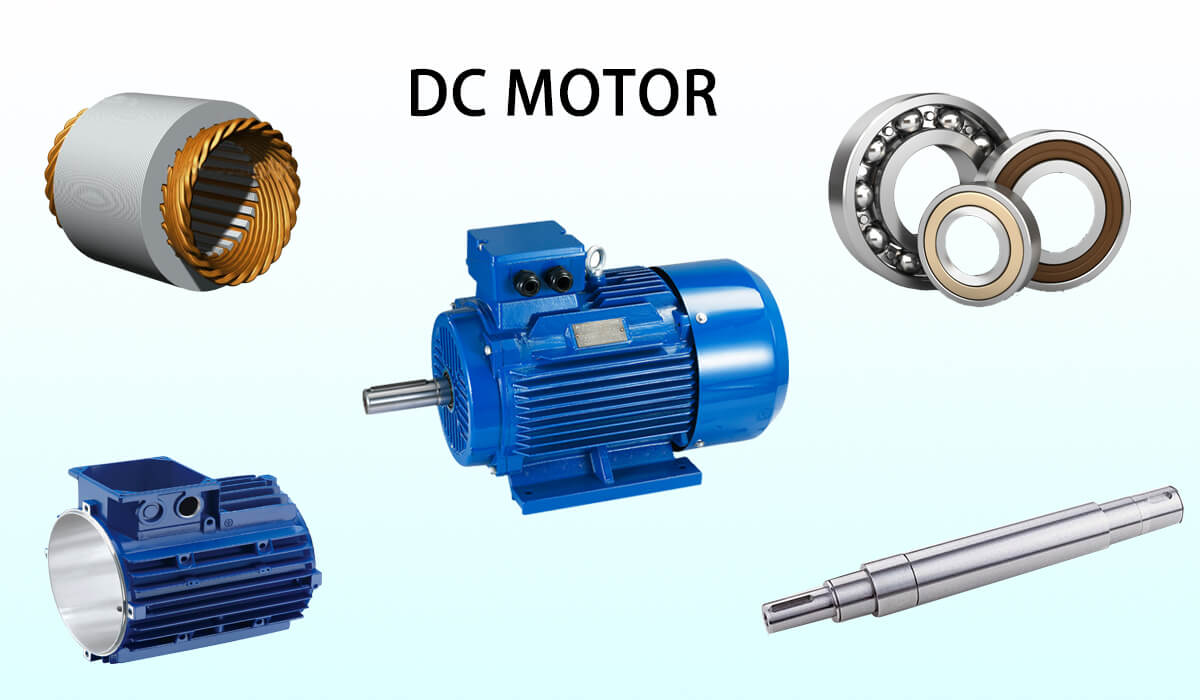
The stator is the stationary part of a DC motor that provides the magnetic field required for operation. It usually consists of permanent magnets or electromagnetic coils (field windings). This magnetic field interacts with the rotor’s magnetic field to create motion. In permanent magnet motors, the field is constant and simple, whereas in field-winding motors, the electromagnets are energized to produce an adjustable magnetic field to meet different performance requirements. The stator also serves as the outer frame that holds everything together and guides the magnetic force.
Rotor (Armature)
The rotor, also known as the armature, is the rotating part of the motor. It consists of coils of wire wound around a laminated iron core. When electric current passes through these windings, it generates a magnetic field that interacts with the stator’s field, producing torque that causes the rotor to spin. Mounted on a shaft and supported by bearings, the rotor provides mechanical power to the connected load and is the main moving part that drives machines and tools.
Commutator and Brushes
The commutator is a cylindrical, split copper ring attached to the rotor’s shaft, while the brushes—made of carbon or graphite—are in contact with it. Together, they act like a switch that reverses the current direction in the armature windings every half turn. This ensures that the torque remains constant and the rotor keeps spinning in the same direction. The brushes transfer electric current from an external power source through the commutator into the armature. Because they are in constant contact with the rotating surface, brushes in brushed DC motors can wear out over time and require regular maintenance.
Shaft
The shaft transmits the rotor’s mechanical energy to an external load. It rotates together with the armature and can drive gears, pulleys, fans, or other mechanical systems depending on the application. The motor’s construction must ensure smooth rotation and minimal vibration for efficiency and durability.
Bearings
Bearings support the rotor and shaft, allowing them to rotate freely with minimal friction. They are positioned at both ends of the shaft and are designed to handle both radial and axial loads during operation. High-quality bearings help reduce wear, noise, and heat generation, thereby extending motor life.
Frame or Housing
The frame serves as the motor’s outer shell, providing structural support and protection for its internal components. It can also act as a heat sink to help dissipate heat generated during operation. In industrial settings, frames may include ventilation slots or fans to improve cooling and extend the motor’s service life.
Power Supply
The power supply provides the direct current (DC) needed to operate the motor. When DC voltage is applied, it flows through the brushes and commutator into the armature coil, creating the electromagnetic force that drives the motor.
In simple terms, the stator creates the magnetic field, the rotor converts it into motion, the commutator and brushes maintain continuous rotation, and the power supply feeds the entire system—together forming the core of a DC motor’s operation.
DC motor working principle
A DC motor converts electrical energy into mechanical motion through electromagnetic force. The operation is based on a fundamental physical law: a conductor carrying current in a magnetic field experiences a force. This concept, discovered by physicist André-Marie Ampere and formalized by the Lorentz Force Law, is the foundation of all DC motor operation.
When electric current flows through the armature (rotating coil) placed in a magnetic field, it experiences a sideways push — the Lorentz force — which causes the rotor to turn. This movement transforms electrical energy into mechanical energy, powering various machines and tools.
The Basic Concept: Electromagnetic Force
When an electric current passes through a wire in a magnetic field, a force acts on the wire. The direction and strength of this force depend on the current direction and the magnetic field’s orientation. This interaction produces the torque that turns the rotor inside the motor.
Direction of Force: Fleming’s Left-Hand Rule
To determine the direction of motion in a DC motor, Fleming’s Left-Hand Rule is used:
Forefinger = Magnetic field (from North to South)
Middle finger = Current (from positive to negative)
Thumb = Force or motion direction
When the magnetic field and current are at right angles, the resulting force drives the rotor in a specific direction, creating rotation.

Torque Generation
In a simple two-sided coil placed between the stator magnets, current flows in opposite directions on each side. Using the left-hand rule, one side is pushed up and the other down, creating a turning effect called torque. This torque causes the rotor to spin around its shaft, producing mechanical motion.
Continuous Motion Through Commutation
If the current in the armature stayed constant, the rotor would stop after half a turn because the forces would reverse. To maintain continuous rotation, DC motors use a commutator — a split metal ring — working with brushes that act as a mechanical switch. Every half turn, the commutator reverses the current direction in the armature windings, ensuring that the torque keeps acting in the same direction. This allows smooth and sustained motion of the motor shaft.
Energy Conversion Process
DC motors perform energy conversion through these steps:
- The armature conductors in the magnetic field experience the Lorentz force.
- This force produces a torque that causes the rotor to spin.
- The spinning rotor transmits mechanical energy to the shaft, powering external loads.
- The applied voltage or current can be adjusted to control speed and torque efficiently.
Role of Magnetic Fields
DC motors rely entirely on magnetic fields for operation. These fields can be produced in two ways:
Permanent magnets are used in small motors (like those in toys or small appliances).
Electromagnets (field windings) are used in larger industrial motors.
The interaction between the stator’s magnetic field and the armature’s magnetic field produces rotational torque. The stronger this interaction, the higher the torque output of the motor.
In summary, a DC motor operates by the interaction of current and magnetic fields, which generate torque, with the commutator ensuring continuous rotation. Together, these elements convert electrical energy into smooth, controlled mechanical motion.

Conclusion
DC motors have been a cornerstone of electric motion systems for over a century. They work by converting electrical energy into mechanical energy through electromagnetic force — the interaction between the magnetic field and the current-carrying armature.
Commutation ensures continuous rotation by reversing the current at the right moment, allowing precise control of speed and torque. Because of their reliability and flexibility, DC motors are widely used in robotics, electric vehicles, consumer electronics, and industrial machinery.
As technology advances, the industry continues to shift toward high-efficiency brushless DC (BLDC) motors, which offer longer lifespans, reduced maintenance, and improved energy efficiency — making them ideal for the next generation of smart and sustainable systems.
At Zhenli Motor, we take pride in being a professional DC motor manufacturer in China, dedicated to delivering high-quality brushed and brushless DC motors for a wide range of applications. If you’re looking for reliable, efficient, and customizable DC motor solutions, contact Zhenli Motor today — and let’s power your innovation together.