
Electric generators and motors play a vital role in modern technology by enabling the conversion of mechanical and electrical energy. These devices form the backbone of numerous applications, ranging from power generation and transportation to home appliances and industrial automation.
An electric generator is a device that converts mechanical energy into electrical energy, supplying the power that industries, businesses, and households rely on every day. On the other hand, an electric motor does the reverse—it converts electrical energy into mechanical energy, driving everything from appliances and tools to vehicles and industrial machines.

Although they share some similarities in design and construction, their functions are fundamentally different—generators generate electricity, while motors use it to create motion. Understanding the difference between these two devices is more than just technical knowledge; it’s about recognizing how they shape our industries, homes, and daily life. In this article, we will compare and contrast electric generators and motors, exploring their functions, working principles, key differences, and similarities to give you a clearer view of their essential roles in modern technology.
What is an electric generator?
An electric generator is a device that converts mechanical energy into electrical energy, making it one of the most important inventions in modern technology. It allows electricity to be generated from motion by utilizing the principle of electromagnetic induction. Without generators, industries, businesses, and households would struggle to access reliable power.
Basic principle: electromagnetic induction
The working principle of an electric generator is based on Faraday’s Law of Electromagnetic Induction. When a conductor passes through a magnetic field, it experiences a change in magnetic flux. If the conductor is part of a closed circuit, this change induces an electromotive force (EMF), leading to the flow of electric current. The faster the conductor moves, or the stronger the magnetic field, the greater the induced voltage.
Main components of an electric generator
The two primary components of electric generators are the rotor and stator.
- Rotor (moving part): Connected to a mechanical source such as a turbine, wind, or engine.
- Stator (stationary part): Contains the magnetic field or coils.
As the rotor revolves inside the stator’s magnetic field, electricity is generated. In AC generators, brushes and slip rings help transfer current, while in DC generators, a commutator ensures current flows in one direction.
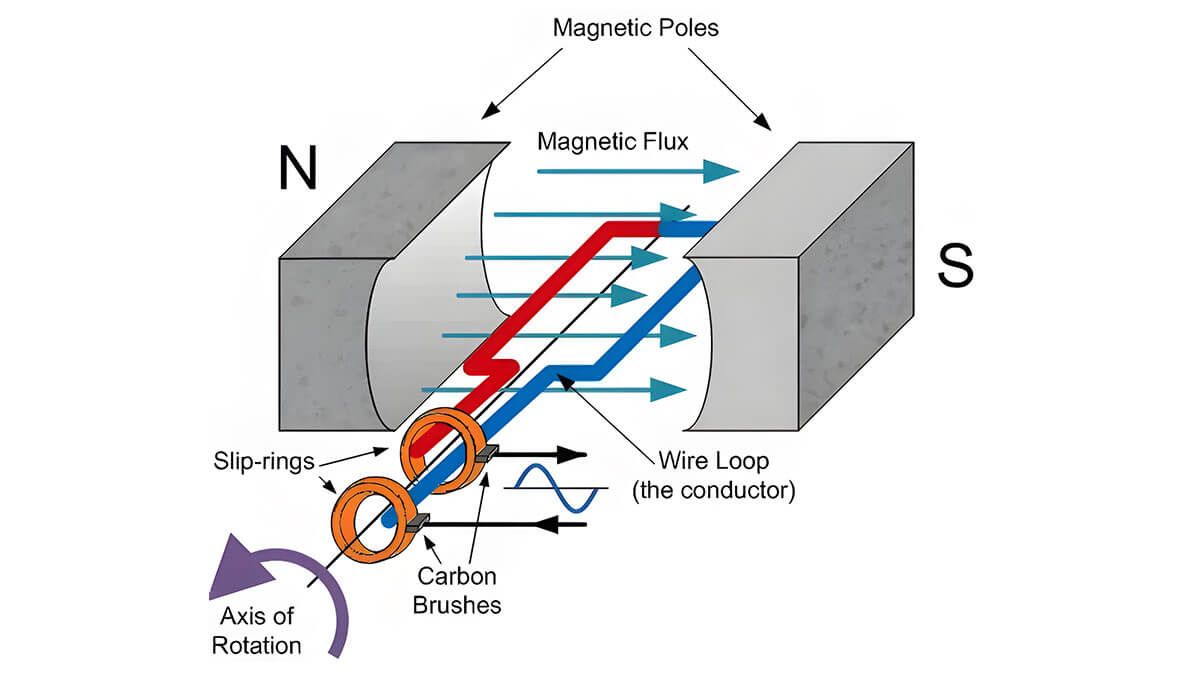
How electrical energy is produced
Mechanical energy from steam turbines, falling water, wind, or internal combustion engines is supplied to the rotor. As the rotor spins inside the stator, an electric current is induced in the windings. This current then flows to an external circuit, producing usable power. Efficiency depends on the generator’s design, magnetic field strength, and rotational speed.
Types of electric generators
- AC generators (alternators): Produce alternating current, widely used in homes, industries, and power plants.
- DC generators: Produce direct current, used in battery charging, electrolysis, and specialized applications.
- Portable generators: Compact, fuel-powered units for homes, construction sites, outdoor events, and emergency use.
- Industrial and standby generators: Large systems in hospitals, data centers, and commercial buildings, often diesel or natural gas-powered, that ensure uninterrupted electricity during outages.
Importance of generators
Electric generators power homes, factories, hospitals, vehicles, and entire cities. They also serve as essential backup systems and play a key role in renewable energy solutions like wind turbines and hydroelectric dams, helping convert natural forces into clean, usable electricity.
What is an electric motor?
An electric motor is a device that converts electrical energy into mechanical energy, making it the counterpart of an electric generator. Motors are everywhere in daily life, powering the machines and tools we rely on — from household appliances to advanced industrial equipment.
Principle of motor operation
Electric motors operate on electromagnetism and the Lorentz force, which states that a current-carrying conductor in a magnetic field experiences a force. Inside the motor, electricity flows through coils of wire, interacting with the magnetic field produced by permanent magnets or electromagnets. This interaction causes the rotor (the rotating part) to turn, generating mechanical motion.
This rotation is then used to perform work, such as spinning a fan’s blades, turning a washing machine’s drum, or driving the wheels of an electric vehicle. By adjusting voltage, current, and magnetic fields, the motor’s speed, torque, and direction can be controlled. Advanced motors often use electronic controllers for precise operation in robotics, automation, and electric vehicles.

Main components of an electric motor
- Rotor: The rotating part that delivers mechanical output.
- Stator: The stationary part that produces the magnetic field, either from permanent magnets or energized coils.
- Windings: Coils of wire carrying current, responsible for torque and efficiency.
- Commutator and brushes (in DC motors): Used to switch current direction and maintain continuous rotation.
Types of electric motors
- AC motors: Operate on alternating current and are widely used in household appliances and industrial systems. They include induction motors, known for their durability and low maintenance, and synchronous motors.
- DC motors: Run on direct current, offering excellent speed and torque control. Found in electric bikes, tools, and lab equipment. They come in brushed and brushless designs, with brushless motors offering higher efficiency and longer lifespan.
- Stepper motors: Rotate in fixed steps, allowing precise positioning. Common in robotics, CNC machines, and 3D printers.
- Servo motors: Compact, high-torque motors with feedback control for precision applications such as robotics, cameras, and automated manufacturing equipment.
Importance of electric motors
Electric motors are indispensable across industries and in daily life. They power fans, pumps, refrigerators, and washing machines at home; drive conveyor systems, machinery, and automation equipment in factories; and serve as the backbone of electric vehicles, trains, and renewable energy systems.
Key differences between an electric generator and an electric motor
Although electric generators and electric motors share similar construction and rely on electromagnetic principles, their functions are fundamentally opposite. A generator converts mechanical energy into electrical energy, while a motor converts electrical energy into mechanical energy. Understanding these differences is essential to seeing how energy flows in modern systems.
Purpose and function
- Generator: Designed to generate electrical energy from an external mechanical source, serving as the starting point in an energy distribution chain.
- Motor: Designed to harness electrical energy and convert it into mechanical work, used wherever motion or rotation is needed.
Direction of energy conversion
| Device | Energy conversion |
|---|---|
| Generator | Mechanical → Electrical |
| Motor | Electrical → Mechanical |
Operating principles
- Generator: Works on Faraday’s Law of Electromagnetic Induction — electricity is induced when a conductor moves in a magnetic field.
- Motor: Works on the Lorentz Force Law — a conductor carrying current in a magnetic field experiences a force, causing motion.
Input source
- Generator: Requires mechanical input (turbine, engine, water flow, wind).
- Motor: Requires electrical input (grid, battery, or generator).
Output type
- Generator: Produces electricity (AC or DC).
- Motor: Produces mechanical motion, usually rotational torque.
Constructional similarities and differences
Both have rotors, stators, and windings. Generators may include commutators, slip rings, and voltage regulators. Motors may include brushes (in DC motors) or controllers (in brushless or AC motors) to manage speed and direction.
Application context
- Generator: Power plants, renewable energy stations, hospitals, data centers, portable backup systems.
- Motor: Appliances, fans, washing machines, elevators, electric vehicles, robotic arms, and industrial machinery.
Dependence on energy sources
- Generator: Relies on mechanical energy from sources like fuel, wind, or water.
- Motor: Relies on electricity supplied by grids, batteries, or generators.
Control and operation
- Generator: Usually requires minimal control once running, except for managing input speed and load fluctuations.
- Motor: Often integrated into control systems (controllers, drives) to regulate speed, torque, and direction for automation and precision tasks.
Similarities between electric generator and electric motor
Despite having opposite functions — one generates electricity and the other uses it — electric generators and electric motors share many structural and operational features. Both are rooted in electromagnetic theory and often use similar components and construction techniques. Understanding these similarities highlights how closely related their designs and functions are.
1) Common foundation in electromagnetism
Both devices rely on electromagnetic principles to function. Generators use Faraday’s Law to create electric current by moving a conductor in a magnetic field, while motors use the Lorentz force law to generate motion from current in a magnetic field. These laws are two sides of the same principle, which is why one device can be made to act as the other under specific conditions.
Generators and motors typically include:
- Rotor (rotating part): Produces or consumes mechanical energy.
- Stator (stationary part): Houses coils or magnets to enable energy conversion.
- Windings (coils of wire): Carry current or generate it through induction.
- Magnets or electromagnets: Provide the magnetic field needed for operation.
- Brushes and commutators/slip rings (in certain designs): Maintain electrical contact with rotating components.
3) Reversibility
One of the most interesting similarities is that motors can function as generators and vice versa. For example, in electric vehicle regenerative braking, the motor acts as a generator, converting kinetic energy back into electricity to recharge the battery. Similar applications appear in elevators, trains, and treadmills, where energy recovery is valuable.
4) Electromechanical energy conversion
Both machines are electromechanical devices that bridge the gap between electrical and mechanical energy. Generators convert motion into electricity, while motors convert electricity into motion. In modern infrastructure, these two processes are inseparably linked, with generators supplying the power that motors consume to perform work.
5) Importance in power and motion systems
Generators and motors are equally crucial in energy systems. Generators provide the electricity that motors need, creating a complete cycle of energy conversion. In power grids, generators supply electricity, while motors run household appliances, industrial machines, and vehicles — illustrating their complementary roles.
Technological improvements often apply to both devices. Advances in magnetic materials, cooling systems, and control electronics enhance efficiency and reliability. For example, brushless designs reduce wear and maintenance in both motors and modern alternators, while smart controllers and variable frequency drives (VFDs) improve performance and efficiency.
7) Similar challenges and maintenance
Both face challenges such as overheating, bearing wear, insulation degradation, and reduced efficiency. Regular maintenance — lubrication, cleaning, and inspection of connections and windings — is vital to ensure long-term performance. Reliability, safety, and minimizing downtime are common priorities in both cases.
Applications of electric generators
Electric generators are central to producing electricity across industries. They power large-scale plants fueled by coal, natural gas, nuclear energy, or renewable resources such as wind and hydro. In residential and commercial settings, generators provide backup power during outages, while portable units are essential for outdoor activities, construction, and remote job sites. For homes and businesses in remote or developing regions, small-scale generators often serve as the primary electricity source.
Importance of electric generators
Generators extend far beyond industrial use. They bring electricity to areas without reliable grid access and serve as life-saving tools for hospitals and emergency services during natural disasters. Their ability to run on renewable resources also makes them vital in sustainable energy solutions. As demand grows for cleaner, more reliable electricity, innovations in design, efficiency, and environmental performance will shape their future role in the global energy system.
Applications of electric motors
Electric motors are everywhere, from the smallest household devices to massive industrial machinery. In homes, they power fans, blenders, refrigerators, and air conditioners. In transportation, motors drive electric vehicles (EVs), trains, and even emerging aircraft designs. In industries, they run conveyor belts, pumps, mixers, and heavy machinery. Motors are also essential in HVAC systems, elevators, escalators, robotics, and precision control systems, making them indispensable in automation and modern manufacturing.
Importance of electric motors
Electric motors are fundamental to daily life and modern technology. They are efficient, reliable, and increasingly favored over combustion engines for being cleaner, quieter, and cost-effective. With the global push toward electrification and sustainability, motors are key in reducing emissions and improving energy efficiency. Advancements continue to focus on higher power density, compact designs, and precise control, enabling their integration into smart homes, electric vehicles, renewable energy systems, and advanced automation.
Practical real-world examples
- Hydroelectric power plants: Turbines spin generators to produce massive amounts of electricity for cities.
- Electric vehicles: Motors convert battery energy into smooth, efficient motion.
- Emergency backup: Portable generators provide power during outages, camping trips, or outdoor events.
- Household comfort: Ceiling fans and appliances powered by motors enhance daily living.
- Industrial operations: Generators supply emergency backup for factories, while motors keep conveyor belts, pumps, and production lines running.
Together, electric generators and motors complete the cycle of power and motion — one produces the energy, and the other puts it to work — making them inseparable pillars of modern technology.
Conclusion
Electric generators and motors are inseparable pillars of modern technology. Generators convert mechanical energy into electrical energy, while motors do the reverse — transforming electrical energy into mechanical motion. Though their functions are opposite, both rely on the same electromagnetic principles and work together to power industries, transportation, homes, and countless machines we depend on every day.
As a professional electric motor manufacturer in China, Zhenli Motor is committed to advancing this vital connection through high-quality, reliable, and efficient motor solutions. By combining innovation with manufacturing expertise, we ensure our products meet the growing demand for performance, durability, and energy efficiency.
Partner with Zhenli Motor today and let our expertise help you succeed.